Categories
Professional-Organizer

Declutter Shoes

Clear the old out and make room to breathe.

As with clothing, when I acquire shoes, I have a rule to let go of as many pairs as I bring in to make room for the new. It’s tough! But reality is, many of us only wear a few favorite pairs and let the others sit to gather dust.

Let ’em go when…

  1. They are worn to the breaking point, the sole or heal is warped, torn, or coming off and you’re not willing to drop them off at a shoe repair shop this week to fix.
  2. They have not bedazzled your feet for a year or two. Like clothes, if shoes are not worn over the last winter, spring, summer, nor fall, they probably never will be. Do you own a pair of special occasion shoes? Have you worn them lately? Are they covered with dust so thick you can no longer tell the color? Are they still in style?
  3. They are no longer your color, size, style, or worth the pain. No longer your color? Are they a style from an era long past that you shouldn’t be revisiting? Has the size of your foot changed? Do they hurt your feet? There’s no such thing as a “break in period” with shoes, in my opinion. If they hurt on day one, they don’t belong on your body. Your feet are precious, and bad-fitting shoes can do serious damage.
  4. They are ugly or dirty beyond cleaning. We are known to buy things we don’t truly like because it’s on sale, or keep something that was a gift and feel bad at the thought of getting rid of it. “What if Aunt Wanda comes over and doesn’t see me wearing them?” Aunt Wanda probably gave you the shoes she bought on sale for herself and realized she didn’t like them when she got home. “They just need to be shined and they will look great!” If so, now is the time to take out the polish and get the job done, or drop them off at the shoe repair shop this week for a professional cleaning.

When it’s time to let go…

Step One – Declutter

  • Take a “Before” photo of your shoe space.
  • Prepare the floor or a large nearby surface to place shoes onto. Use an old sheet or blanket you’re willing to get dirty if using the bed.
  • Have on hand plenty of bags for donations or consignments.
  • Grab a pen and pad of paper for notes or use the notepad on your cell phone (“Take shoes for cleaning and repairing.”)
  • Prep a bottle of all-purpose cleaner, a rag, broom, or vacuum cleaner.
  • Grab a shoe brush and the shoe polishing kit. Don’t have one? A clean, soft rag will do.
  • Go through each pair of shoes, and put what you no longer want in the “Donation” or “Consignment” bags. Set aside each pair you keep.

Step Two – Clean

  • Dust, sweep, mop, or vacuum the area where you will put the shoes back. So many dust bunnies! Dust is made up of dead skin cells, pet dander, dirt you’ve trekked in on your shoes, pollen, and other things from outside. This is a reason why so many people have “no shoes” rules in their homes.
  • Dust each pair of shoes thoroughly with a shoe brush or clean rag. Do this outside or out an open window. You can also gently vacuum dust from inside each shoe with an attachment hose.
  • If you have time, polish the shoes that need it most before putting them back. Or set those aside to be professionally cleaned, polished, or to repair.
Step Three – Organize

  • If going back onto a shelf, rack, or the floor, display shoes front forward as you find them in a department store.
  • If you need to maximize space, place one shoe forward and the other in the opposite direction, heel showing. This magically creates space both on shelves and in hanging shoe nooks. Try it!
  • Still not enough room? Place sandals and flats upright in a basket to store on a shelf or the floor.
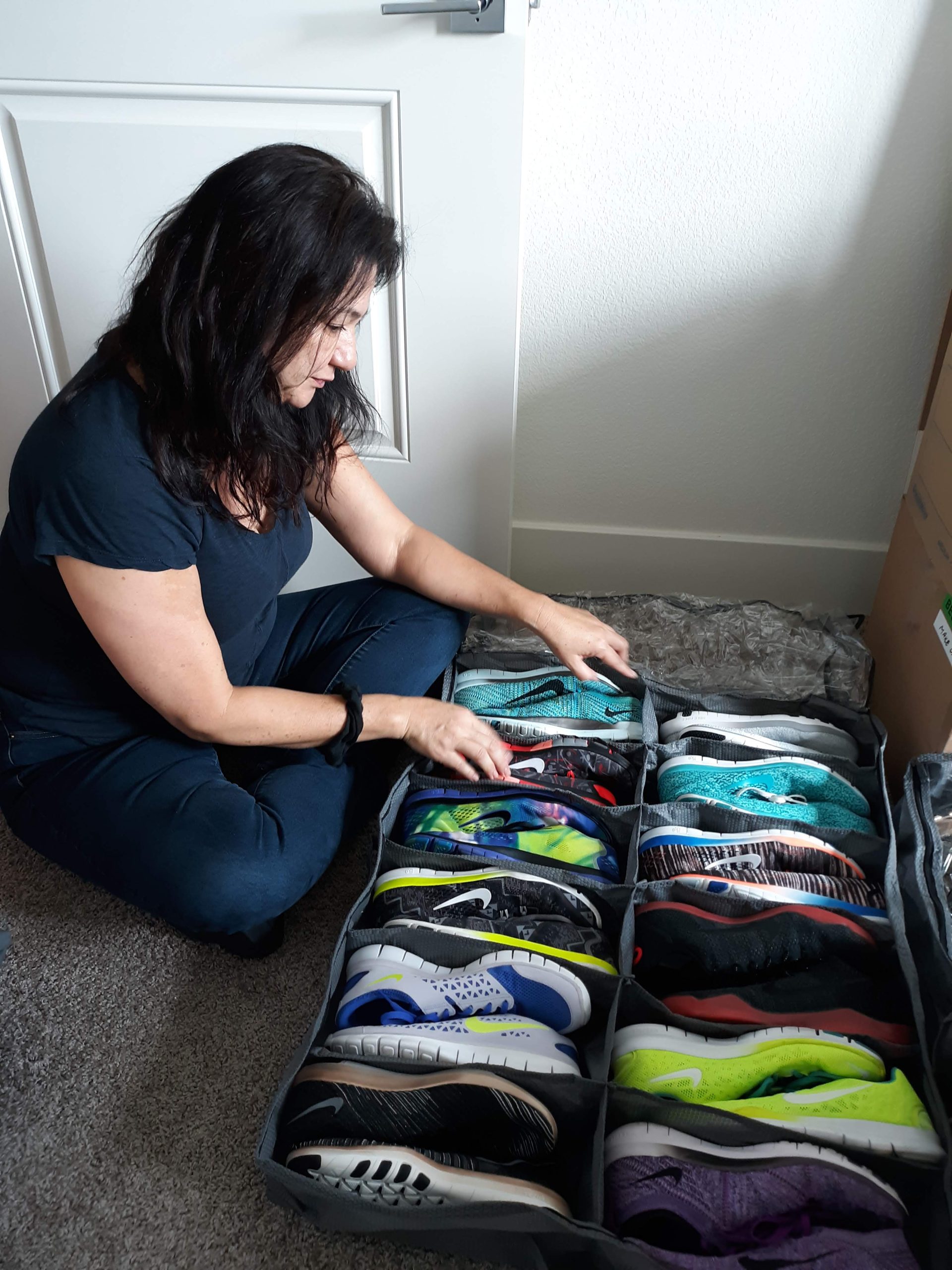
  • Use an under-bed shoe organizer that zips closed and is easy to quickly slide out to grab what you need.
  • Roll up old magazines and place inside tall boots to help keep their shape.
  • Take an “After” photo of your fresh and organized shoe space.

Considering selling or consigning unwanted shoes? Read about my favorite places to do that!


Bella_Organizing_Best_Professional_Organizers_San_Francisco_Oakland_Berkeley_silicon_valley_monterey

Isabella Guajardo, founder and owner of Bella Organizing, is a San Francisco Bay Area professional organizer offering home organizing and residential move management services throughout the Greater San Francisco Bay Area. Call (510) 229-7321 or email info@bellaorganizing.com for more information. Gift certificates are available.


Categories
Professional-Organizer

Declutter the Wardrobe Closet

Say farewell to what you don’t need and magically create space that makes cleaning, organizing, and finding things easier.

When I acquire clothing, I have a rule to let go of as many as I bring in to make room for the new and stay uncluttered. I reinforce this rule by only owning a certain number of hangers (I hang 90% of my clothes.)

Let it go when:

  1. It’s been worn to the point that it is fading, pilling, stretching, or tearing. Why stroll around in public with a t-shirt that’s old and raggedy? The two old t-shirts I own are for gardening and dying the hair. If there’s something waiting to be mended and it’s been waiting a long time, it’s time to get it done or let it go.
  2. It has not been worn for an entire year. If a piece of clothing has not bedazzled the body over the last winter, spring, summer, nor fall, it likely never will. This includes those “skinny” clothes; the things we keep telling ourselves year after year that we will fit back into someday.
  3. It is no longer your color, size, or style. Why wear something and get annoyed every time you put it on? Not your color? Not tailored for your body? Just a little too tight or baggy? If it doesn’t make you feel fabulous or fit just right, are you ready to take it to the tailor and pay to get it fixed?

“Well…I kinda like it…but….”

Let’s get started…

Step One – Declutter the wardrobe closet & dresser drawers

  • Prepare a nearby surface on which to place clothes. A clean, made bed will do.
  • Have on hand plenty of trash or paper bags for donations or items to consign.
  • Prep a bottle of all-purpose cleaner or mild soap, a clean sponge or rag, broom, and mop or vacuum cleaner.
  • Grab a pen and pad of paper for notes or use the notepad on your cell phone.
  • Go through the hanging clothes and immediately remove the absolute “must go’s” first. Put what you no longer want in bags marked for “Donations” or “Consignment/Sell” bags. Leave hanging what you want to keep. Set aside the “maybe’s.”
  • Try on the “maybe’s” if you have time. If you cannot decide now, re-assess them again in a few months.
  • Do the same for clothing on shelves and those that have toppled to the ground. Go through dresser drawers and anywhere else you keep and store clothing, socks, and undergarments. Purge the old, worn, and unwanted. If you need help seeing the truth about the condition of something, call in a friend, housemate, or family member for assistance.

Step Two – Clean

  • Clean inside the closet and dresser drawers and sweep, mop, or vacuum while you’re here. So many dust bunnies! Dust is made up of dead skin cells, pet hair, pollen, and dirt you’ve trekked in on your shoes from the outdoors, amongst other things.

Step Three – Hang, Fold, and Organize

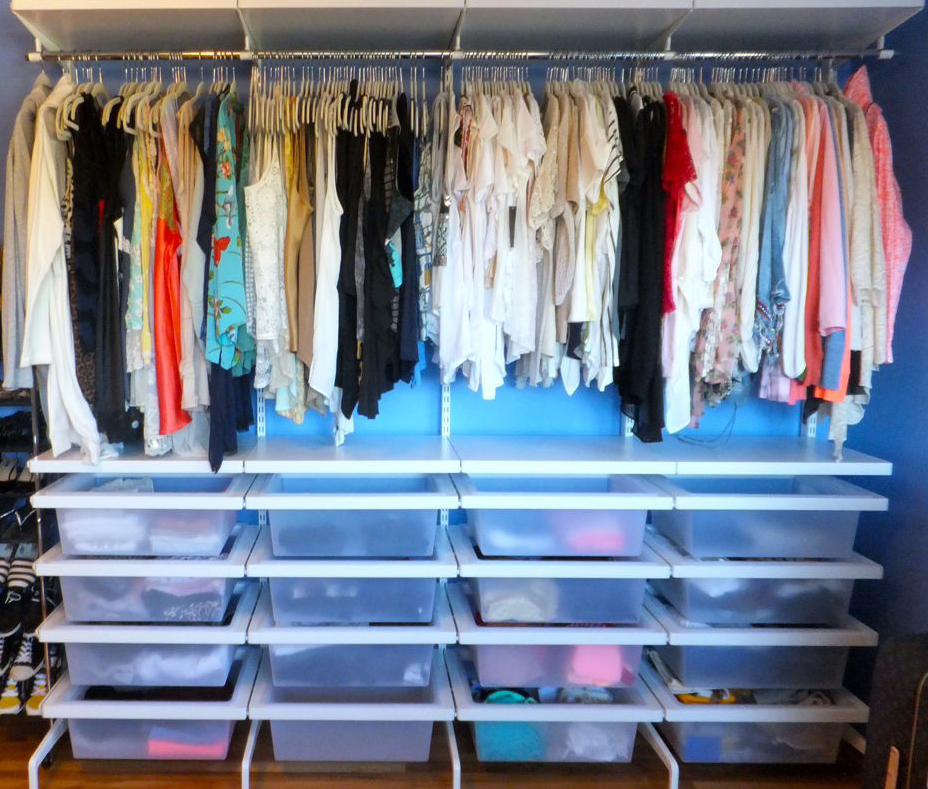
  • Hang as many clothes that comfortably fit into the closet. This includes tank tops, workout tops, and lingerie if there’s room and enough hangers. Hanging keeps things neat, wrinkly free, in sight, and easy to access. Arrange clothes like with like and in order: tanks (toward the front), sleeveless, short-sleeve, long-sleeve, sweaters, jackets (toward the back,) etc.
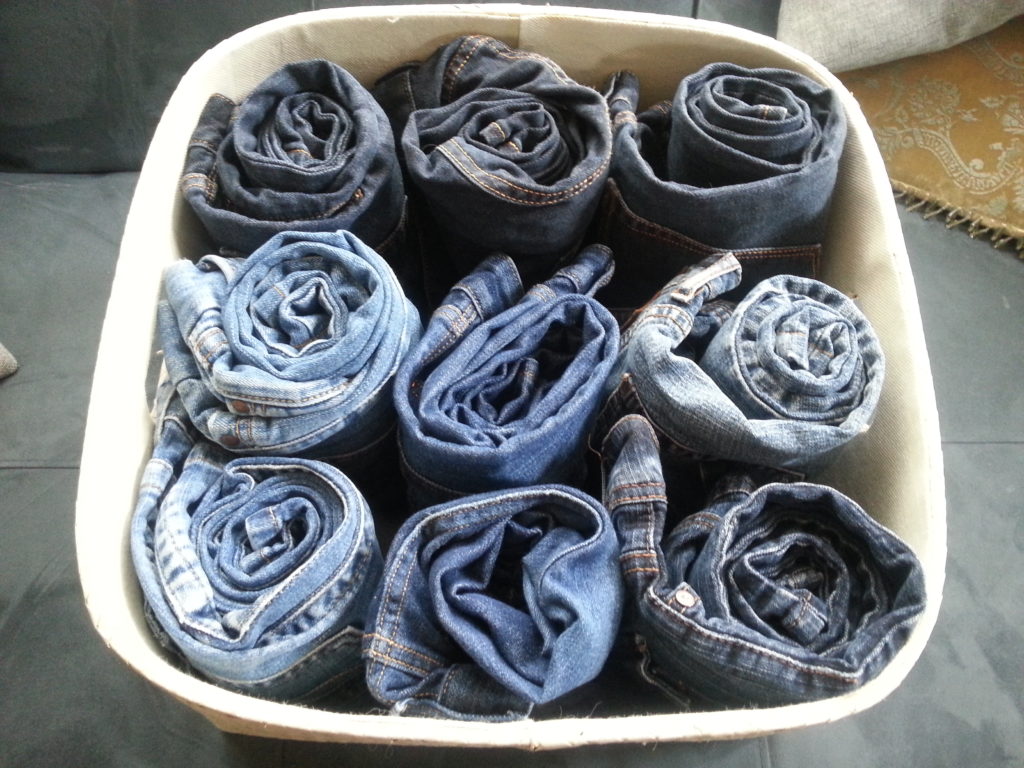
  • Neatly fold or roll clothes that go back into drawers, bins, or baskets. Here are tutorials for tips on How To Fold T-shirts, long socks and leggings, yoga pants.
  • Take an “After” photo of your fresh and clean closet and dresser drawers.

Considering selling or consigning unwanted clothing and accessories? Read about my favorite places to do that!

Ready to go a step further with closet organization? Read my blog on how to maximize closet space with hangers. 

Rolled jeans in a basket...my favorite!
Rolled jeans in a basket.

Bella_Organizing_Best_Professional_Organizers_San_Francisco_Oakland_Berkeley_silicon_valley_monterey

Isabella Guajardo, founder and owner of Bella Organizing, is a San Francisco Bay Area professional organizer offering home organizing and residential move management services throughout the Greater San Francisco Bay Area. Call (510) 229-7321 or email info@bellaorganizing.com for more information. Gift certificates are available.
Categories
Professional-Organizer

Declutter the Junk Drawer

Declutter First, Organize Next. 

Discard what you don’t need and it magically creates space that makes cleaning and organizing easier. Let go of the old and unnecessary, expired, used up, what upsets you, what’s no longer your style, and that which takes up space you need for something more meaningful. It’s time to say goodbye and move on…  

Step One – Declutter the Junk Drawer

utility_junk_drawer_before_after_bella_organizing
  • Clear off a nearby surface on which to place things coming out of the drawer.
  • Gather one or more paper grocery bags for discards. Label one “Hazardous/E-Waste.” Have another bag handy to carry things that need to live elsewhere in the house. Keep the trash and recycle bins nearby. Read about what is considered Hazardous Waste and how to properly dispose of it.
  • Prep a bottle of all-purpose cleaner or mild soap, and a clean sponge or rag.
  • Grab a pen and pad of paper for notes, or use the notepad on your cell phone.
  • Open the junk drawer and take a few “Before” photos.

IMPORTANT REMINDER: Old and expired batteries and any kind of cords or wires, working or not, is hazardous waste and should not be thrown in the trash, recycle bin, or poured down drains. Take the following steps and avoid putting mother earth in danger.

earth_911_logo

Prepare to Drop Off Household Hazardous and e-Waste

One of the safest ways to dispose of old batteries, lightbulbs, cords, wires, and other types of electronic “e-waste” is during drop-off days that local businesses, schools and community organizations host throughout the year. You can also go to Earth911.com or do in Internet search for a “household hazardous waste center” to find drop-off locations near you. Whether you rent or own, most waste management companies have special directions for you to follow to properly dispose of hazardous waste locally to you and often free of charge, check your local waste management company’s website for details.

Now that you know how to properly handle hazardous and e-waste…

  • Take everything out of the drawer. Toss what you no longer want into the trash, recycle bin, in a donate/giveaway pile, or into the “hazardous waste” bag. Don’t know if the batteries are good? Watch this Youtube video for a quick way to check.
  • Is there anything in the drawer that belongs elsewhere in the house or garage? If so, take it where it needs to be.

Step Two – Clean 

  • Clean inside the drawer with a wet and warm, soapy cloth. Allow the surface to dry completely before putting things away. You may want to put down drawer liner to protect the surface from future damage. Spongy liner works great for keeping things from rolling around. 

Step Three – Put Things Back and Organize Your New “Utility” Drawer

creatively reuse small gift boxes for office and utility supplies.
Creatively reuse small boxes for office and utility supplies. Use old jewelry gift boxes, iphone boxes, or colorful business card boxes like these.
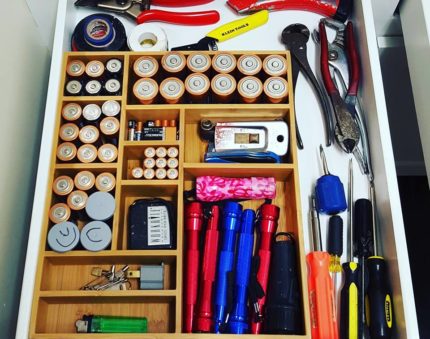
  • Now that you are cleaning out the drawer, is there anything left to go back in it? What should an organized “Utility” drawer consist of?
  • Useful items for a “Utility” drawer may include a screwdriver, scissors, pliers, utility knife, marker, pen, notepad, a few rubber bands, small roll of tape, small ball of twine, small flashlight, fresh batteries, safety pins, tweezers, tape measure, lighter or matches, small emergency sewing kit, a few band-aids, a couple small binder or chip clips.
  • If you continue to keep chargers, cords, or wires in the drawer, roll up and keep them in check with a rubber band or velcro cord strip.
  • Return what belongs back to the drawer.
Bella_Organizing_Best_Professional_Organizers_San_Francisco_Oakland_Berkeley_silicon_valley_monterey

Isabella Guajardo, founder and owner of Bella Organizing, is a San Francisco Bay Area professional organizer offering home organizing, interior redesign, and residential move management services throughout the Greater San Francisco Bay Area. Call (510) 229-7321 or email info@bellaorganizing.com for more information. Gift certificates are available.
Categories
Professional-Organizer

Declutter the Medicine Cabinet

Declutter First, Organize Next. 

Discarding what you do not need is key to creating valuable space that will make cleaning and organizing easier. Let go of the old, expired, outworn, used up, what upsets you, what’s no longer your style, and that which takes up space you need for something more meaningful. It’s time to say goodbye and move on…

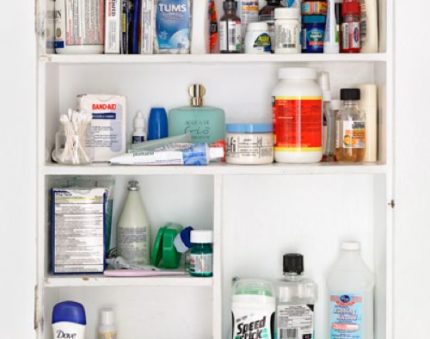
 Declutter the Medicine Cabinet
medicine_cabinet

Step One 

  • Prepare a nearby tabletop surface on which to place things when removing them from the cabinet. Avoid bending down and putting items on the floor whenever possible (saves the back).
  • Gather one or more paper grocery bags for discards. Label one “Hazardous Waste” and another “Donate” (for items still in good condition that you plan to give away.)
  • Prep a bottle of all-purpose cleaner or mild soap, and a clean sponge or rag.
  • Grab a pen and pad of paper for notes, or use the notepad on your cell phone in case you come up with a thing or two for your “To Do” list.
  • Open the medicine cabinet and take a few “Before” photos.

IMPORTANT REMINDER: Old and expired medicine AND vitamins is hazardous waste, and can turn into something potentially dangerous. You can’t just flush them down the toilet or toss them in the trash. Take the following steps and avoid putting anyone or anything – people, kids, pets, fish in the ocean – in danger.

earth_911_logo

Drop them off…

One of the safest ways to dispose of old medicine and vitamins is to take advantage of drug drop-off days your city or local community organizations host throughout the year. The U.S. Environmental Protection Agency recommends drop-off events as the first choice of disposal for over and under the counter drugs, including vitamins. Do an internet search for ones near you or go to Earth911.com for independent drop-off locations. When dropping off anything with your personal information on it, be sure to black out your name and address with a marker. DO NOT black out the drug name, since hazardous waste facilitators need to know what it is. And DO NOT mix a lot of different drugs into one small unmarked bag, for the same reason.

Take them back…

Take unwanted and expired drugs or vitamins back to the store where you bought them if your city or town doesn’t hold drop-off events or if there is not a household hazardous waste collection center near you. If the store has an on-site pharmacy, the employees may be able to properly dispose of them. Speak to your local pharmacist about it.

Do not ever, ever, EVER…

Do not flush old or expired medicine or vitamins down the toilet, cautions the EPA and FDA. While this is a high concern with prescription medications, vitamins can also leach into the water supply and cause safety risks. Don’t dispose of them down drain pipes nor empty them into a garbage or compost bin. Children and animals can get into and eat them.

Lots of other things are stored in medicine cabinets, and many do not have expiration dates. These can include hairspray, hair gel, toothpaste, lotion, face toner, contact lens solution, sunscreen, deodorant…all of which should be considered for disposal, too. How old are they? Do you ever use it? Do you even like it? If it does not have an expiration date and you’ve owned it for more than two years, consider it old. If it’s not face or body soap, nor earth-friendly cleaning fluids meant to go down the drain, it should not go down the drain. Play it safe and place anything else old and unwanted into the hazardous waste bag. Personally, I consider anything made with scientifically named chemicals hazardous waste, and always include it in my next visit to the household hazardous waste center. If anyone’s going to dispose of these things the safest way possible, it’s them.

Now that you know how to handle the discards…

  • Pick up each item in the medicine cabinet and find the expiration date. If it’s expired, it goes into the “hazardous waste” bag. Don’t take chances with old vitamins, medicine, or anything you put in or on the body.
  • Place anything you are keeping on a nearby surface for later.

Step Two 

Clean 

  • Inside and out, wipe the empty medicine cabinet with a wet and warm, soapy cloth. Regular cleaning will keep it in good shape. Allow surface to dry completely before putting things away.


Step Three 

Put Things Back and Organize

  • Return what you keep back to the cabinet, place like items near each other, labels facing forward: medicine, vitamins, hair products, face products, etc.
  • Take an “After” photo of your freshly organized medicine cabinet.
Was this a quick and easy project for you? Are you motivated to declutter more from the bathroom? If so, tackle all the shampoos, conditioners, soap, make-up, and toiletries under the sink, in the shower, or stashed in other areas of the home.

Bella_Organizing_Best_Professional_Organizers_San_Francisco_Oakland_Berkeley_silicon_valley_montereyIsabella Guajardo, founder and owner of Bella Organizing, is a San Francisco Bay Area professional organizer offering home organizing, interior redesign, and residential move management services throughout the Greater San Francisco Bay Area. Call (510) 229-7321 or email info@bellaorganizing.com for more information. Gift certificates are available.
Categories
Professional-Organizer

Declutter the Linen Closet

declutter

1. to remove mess or clutter from (a place).

2. to organize and prioritize (one’s commitments, material possessions, etc.)

3. to let go

Declutter First, Organize Next. 

Pulling out what you no longer want is key to creating space and will make the organizing process smoother. Whether it’s clothing from a hanger, shoes from a rack, books from a shelf, paper from a filing cabinet, or toys from a bin, it’s time to make decisions on the things you are ready to let go. Focus first on decluttering. When the unwanted is out of the way, begin cleaning and organizing.  

Step One – Declutter the Linen Closet

  • Prepare a large, clean, and comfortable surface on which to work and fold. Avoid bending down and putting things on the floor and on surfaces where linens can pick up dust or animal hair. A clean bed, sofa, or dining table will do.
  • Have on hand plenty of trash bags for donations.
  • Prep a bottle of all-purpose cleaner or mild soap, and a clean sponge or rag.
  • Open the linen closet and take a few “before” photos.
  • Remove ALL linens from the closet. Sort like with like as you take them out: Bath towels, hand towels, sheets, duvets, comforters, pillows, dish towels, beach towels, etc.
  • Once sorted, you will know how much of each there are and which sets are matching or missing pieces. This is an important step toward LETTING GO. It’s easier to say goodbye to the old, worn, mismatched, and unwanted if you know there will be enough left to survive.
Allow yourself to let go and help others in need. Shelters always need old towels and small blankets for their ongoing intake and care for animals. You can also drop linens off at a homeless shelter or charity organization of your choice. Shelters accept new and used towel donations year around.

Step Two – Clean

  • Wipe the empty linen closet surfaces and walls with a wet and warm, soapy cloth. Regular cleaning will keep closets and cabinets in good condition. Allow surface to dry completely before putting things away.

Step Three – Fold & Organize

  • There are many great ways to fold towels and linens. Visit these Youtube “how to” videos to see my favorites. 1) Unique towel folding, 2) How to fold a fitted sheet, 3) Types of sheets and how to fold sets together
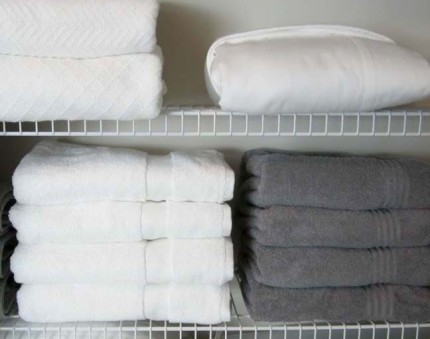
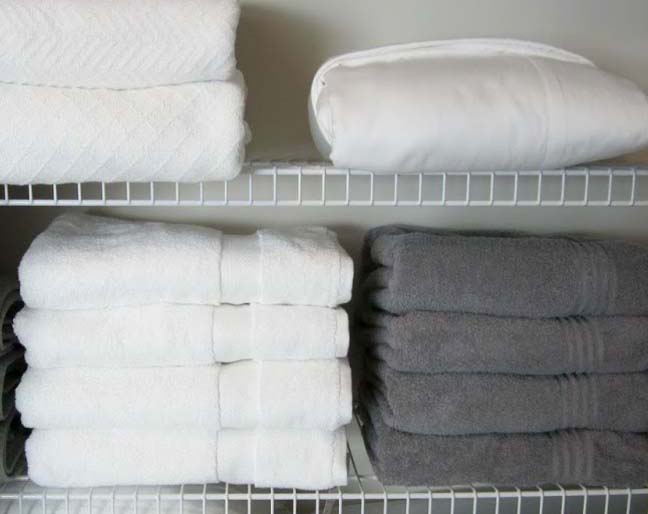
  • When folding towels, sheets, and blankets, consider the width, height, and depth of the area they are going back into. Fold in a way that allows the linens a bit of space between each other once stacked on a closet shelf (see above photo.) Room to breathe!
  • Put like items together (towels, sheet sets, blankets, etc.)
  • Take an “After” photo of your organized linen closet.

Bella_Organizing_Best_Professional_Organizers_San_Francisco_Oakland_Berkeley_silicon_valley_monterey

Isabella Guajardo, founder and owner of Bella Organizing, is a San Francisco Bay Area professional organizer offering home organizing and residential move management services throughout the Greater San Francisco Bay Area. Call (510) 229-7321 or email info@bellaorganizing.com for more information. Gift certificates are available.