Categories
Professional-Organizer

Declutter the Junk Drawer

Declutter First, Organize Next. 

Discard what you don’t need and it magically creates space that makes cleaning and organizing easier. Let go of the old and unnecessary, expired, used up, what upsets you, what’s no longer your style, and that which takes up space you need for something more meaningful. It’s time to say goodbye and move on…  

Step One – Declutter the Junk Drawer

utility_junk_drawer_before_after_bella_organizing
  • Clear off a nearby surface on which to place things coming out of the drawer.
  • Gather one or more paper grocery bags for discards. Label one “Hazardous/E-Waste.” Have another bag handy to carry things that need to live elsewhere in the house. Keep the trash and recycle bins nearby. Read about what is considered Hazardous Waste and how to properly dispose of it.
  • Prep a bottle of all-purpose cleaner or mild soap, and a clean sponge or rag.
  • Grab a pen and pad of paper for notes, or use the notepad on your cell phone.
  • Open the junk drawer and take a few “Before” photos.

IMPORTANT REMINDER: Old and expired batteries and any kind of cords or wires, working or not, is hazardous waste and should not be thrown in the trash, recycle bin, or poured down drains. Take the following steps and avoid putting mother earth in danger.

earth_911_logo

Prepare to Drop Off Household Hazardous and e-Waste

One of the safest ways to dispose of old batteries, lightbulbs, cords, wires, and other types of electronic “e-waste” is during drop-off days that local businesses, schools and community organizations host throughout the year. You can also go to Earth911.com or do in Internet search for a “household hazardous waste center” to find drop-off locations near you. Whether you rent or own, most waste management companies have special directions for you to follow to properly dispose of hazardous waste locally to you and often free of charge, check your local waste management company’s website for details.

Now that you know how to properly handle hazardous and e-waste…

  • Take everything out of the drawer. Toss what you no longer want into the trash, recycle bin, in a donate/giveaway pile, or into the “hazardous waste” bag. Don’t know if the batteries are good? Watch this Youtube video for a quick way to check.
  • Is there anything in the drawer that belongs elsewhere in the house or garage? If so, take it where it needs to be.

Step Two – Clean 

  • Clean inside the drawer with a wet and warm, soapy cloth. Allow the surface to dry completely before putting things away. You may want to put down drawer liner to protect the surface from future damage. Spongy liner works great for keeping things from rolling around. 

Step Three – Put Things Back and Organize Your New “Utility” Drawer

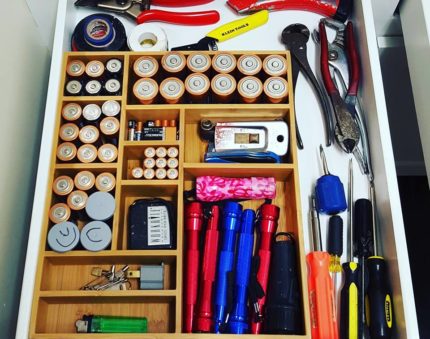
creatively reuse small gift boxes for office and utility supplies.
Creatively reuse small boxes for office and utility supplies. Use old jewelry gift boxes, iphone boxes, or colorful business card boxes like these.
  • Now that you are cleaning out the drawer, is there anything left to go back in it? What should an organized “Utility” drawer consist of?
  • Useful items for a “Utility” drawer may include a screwdriver, scissors, pliers, utility knife, marker, pen, notepad, a few rubber bands, small roll of tape, small ball of twine, small flashlight, fresh batteries, safety pins, tweezers, tape measure, lighter or matches, small emergency sewing kit, a few band-aids, a couple small binder or chip clips.
  • If you continue to keep chargers, cords, or wires in the drawer, roll up and keep them in check with a rubber band or velcro cord strip.
  • Return what belongs back to the drawer.
Bella_Organizing_Best_Professional_Organizers_San_Francisco_Oakland_Berkeley_silicon_valley_monterey

Isabella Guajardo, founder and owner of Bella Organizing, is a San Francisco Bay Area professional organizer offering home organizing, interior redesign, and residential move management services throughout the Greater San Francisco Bay Area. Call (510) 229-7321 or email info@bellaorganizing.com for more information. Gift certificates are available.

Categories
Professional-Organizer

Kitchen Organizing – Creating A Drink Zone

Create a “drink zone” in the kitchen that includes everything you need to make your drinks: coffee, tea, various drink mixes, sugars, honey, mugs, glasses, coffee and tea maker, blender, juicer…

I LOVE when people move! Fresh start! I get to design, set up and organize home offices, living rooms, bedrooms, kitchens. I always have so many IDEAS.

The first thing that needs to be put together is the kitchen. Of course you have to eat and drink coffee and tea in the morning. I put together a series of photos of what I call a “drink zone” from the last home I lived in. I work with clients on kitchen organizing regularly, so these photos give examples of what I’m always talking about with them.

An organized drink zone is a place to store everything you need to make your favorite “for here” and “to go” drinks: coffee, tea, and their implements, cocoa, various drink mixes (such as emergen-c), sugars, honey, mugs, travel mugs, glasses, coffee and tea maker, blender, juicer, etc. Keep in the upper shelves things such as platters and baskets that you will use for serving drinks or drink-related tools and accessories.

Decanting & Labeling

Everyday drink glasses should be placed on the lowest, most reachable shelf, and less commonly used glasses up higher. Here I used a chrome expandable shelf riser/extender purchased from a local home store. The cabinet shelves are adjustable, so I adjusted the area to have enough space to add the extender so that the glasses stack and a hand can comfortably grab and put things away.

kitchen cabinet organizing – everyday drink glasses (or mugs) on lower shelf

Lining kitchen cabinets is sometimes necessary. I like to line the lower, most commonly used dish cabinets. Why? Because it protects glasses from sliding around, from clanking and chipping on the cabinet, and it protects the cabinet from water damage if you put away things without completely wiping them dry. If you rent or are detailed about the resale value of your home, take care of the cabinets. One of my favorite’s is spongy no-slip liner because it’s easy to measure, cut, and place, unlike sticky liner. The brighter the liner color, the brighter it makes the inside of the cabinet, the easier it is to see what’s inside…works especially well in dark spaces.

Shelf liner protects the surface of your cabinets, adding to the resale value of your home.

We move up to the less-commonly used items…the wine and “special occasion” cocktail glasses. Alway have a small step-stool nearby for when it’s time to bring these babies down and par-tay.

Less commonly used glasses go higher up in the cabinet.
Love the tiki cocktail glasses.

We move over to the upper right where the coffee and travel mugs live. Six travel mugs is more than enough for two people.

Coffee and travel mugs.

Many moons ago I had a thrift store collection of cute mugs, but have since pared down to three: the skinny blue one with flowers that I love for hot chocolate, my little sombrero man, and my mama buzz mug. Mama Buzz was a hip local coffee and sandwich shop on Telegraph Avenue in the Temescal District of Oakland back when I first started this business. They were popular for showcasing local art & music before First Friday’s began. It’s since changed hands and is now a beer garden and bustling social hub during the First Fridays Art Murmur. Mama Buzz will forever live in my heart and kitchen cabinet.

My favorite mugs are simple treasures.

The lower-right side of the cabinet is where the coffee, tea, honey, sugar, mexican hot chocolate, mulling spices, emergen-c, coffee filters and drink implements live.

Coffee and tea drink zone.

I like to store loose leaf tea and bags in small, stack-able mason jars where they keep fresh longer and are easy to see. I simply cut the label off and place it in the jar so we can see and read what it is, and know when it’s time to buy more.

Store loose tea bags in mason jars to keep them fresh longer.

The counter top below is specifically for drink-related machines and gadgets: the electric water kettle and coffee maker. The large cabinet below the counter houses the juicer and blender which are too bulky and heavy to keep on the counter but used often enough to store nearby.

I keep mint with its roots in a glass of water by the sunlight to pick when I’m craving fresh tea. Mint is invasive in the garden, so pulling a little out at a time by the roots will keep them thinned. There’s no better tea than fresh mint tea. 

Fresh mint ready for picking.

This is our kitchen drink zone. We add to it only when things break or run out, so that it doesn’t get cluttered. We keep in it things we love, cherish, and use regularly…things that make us happy when we open the cabinet and see them.

Kitchen cabinet organizing – drink station

Ready for more? Call (510) 229-7321 today to schedule a complimentary estimate for your kitchen and pantry organizing goals. Gift certificates are available.

Keep up with Bella Organizing on Facebook and Instagram.

Categories
Professional-Organizer

Apple Galette Recipe

Apple Galette

ɡəˈlet/
noun  – a flat round cake of pastry or bread.

ingredients

  • 1 3/4 cups all purpose flour
  • 1/4 teaspoon salt
  • 3/4 cup (1 1/2 sticks) chilled unsalted butter, cut into 1/2-inch cubes
  • 2 tablespoons ice water (or more as needed)
  • 1 1/2 pounds Granny Smith, McIntosh, Macoun, or Empire apples
  • 4 tablespoons granulated or raw demerara sugar
  • 1 teaspoon finely grated lemon peel
  • 1/4 cup apricot preserves
  • 1 egg or  3 tablespoons whole milk

preparation

Pie crust: You can use a food processor, or make it by hand; I make pie crust using a KitchenAid mixer on the lowest setting. Below is the recipe for using a food processor.

Blend flour and salt in processor. Add butter and blend, using on/off turns, until mixture resembles coarse meal. Add 2 tablespoons ice water and blend just until dough begins to clump together, adding more ice water by teaspoonfuls if dough is dry. Gently gather dough into ball; flatten into disk. Wrap in plastic and chill 1 hour. DO AHEAD: Can be made 2 days ahead. Keep dough chilled (I’m told the secret to great pie crust is keeping the ingredients cold.) Soften slightly at room temperature before rolling out.

Roll out dough between sheets of parchment paper to 1/8-inch-thick round, 14 inches in diameter (it doesn’t have to look perfectly round.) Remove top sheet of parchment. Using bottom sheet as aid, transfer dough on parchment to large unrimmed baking sheet. Chill 15 minutes.

Preheat oven to 450°F. Combine apple slices, 2 tablespoons sugar, and lemon peel in medium bowl; toss to blend. Spread preserves over crust, leaving 1 1/2-inch plain border. Arrange apple slices in concentric circles atop preserves, overlapping slightly. Using parchment as aid, fold plain crust border up over apples, pinching any cracks in crust. Brush crust with lightly beated egg or milk. Sprinkle crust edges and apples with remaining 2 tablespoons sugar.

Bake galette 20 minutes. Reduce oven temperature to 375°F and continue baking until crust is golden, about 30 minutes longer. Keep an eye on the crust. If at any time it starts to darken too much, simply place a sheet of foil over the entire pie in the oven. When baking time is complete, remove pie from oven. Slide long thin knife between parchment and galette. Let stand at least 10 minutes. Cut into wedges and serve warm or at room temperature.

Enjoy!


Isabella Guajardo, also known as Girl With A Truck™, is a professional home organizer and a member of the National Association of Professional Organizers (NAPO). She travels between the San Francisco Bay Area, Silicon Valley, and Monterey Peninsula to get people organized… including kitchens and pantries! Join Bella Organizing on Facebook. Gift certificates are available.