Categories
Professional-Organizer

Breath Light Into Your Home

attic home organizing in berkeley and oakland

Breathe Light Into Your Home

Lighting is a critical element to how well the home looks and functions. Inadequate lighting is a common issue, and often caused by incorrect wattage in lamps and outdated overhead fixtures. This can make a room dark, shadowy and uncomfortable.

Check to make sure the highest watt bulbs recommended by the manufacturer are in your lamps and fixtures. Experiment with clear and frosted bulbs.

Do you have trouble reading in a particular room or while working at your desk? Do you sit close to a window for natural light because the lamps and fixtures direct light upward to the ceiling and not down on the room, book or desk? Is the art, décor, or plants hidden in the dark? If any of this applies to you, it’s time to redesign the lighting in your home and upgrade to what you need. It doesn’t have to cost much.

To properly light your home, you need three types of lighting: general, task, and accent.

GENERAL LIGHTING illuminates the entire room. This includes fixtures that hang on or near the ceiling, and Torchiere lamps that stand on the floor and shine their light up and outward. This also includes Track Lighting, Recessed Lighting, Cove Lighting, Chandeliers, and Sconces.

TASK LIGHTING includes table and standing lamps, strip lighting, or track lighting directed to specific areas, and is an essential element for working and reading comfortably. Swing-arm lamps connected to a wall are versatile task lighting, more commonly placed at the bedside or next to a favorite reading chair. Some Torchiere lamps come with combination up and down lights that provide both general and task lighting. Strip lighting is commonly used under kitchen cabinets to light up countertops.

ACCENT LIGHTING is used to highlight artwork, sculptures, trees, and plants. Properly lit art and accessories can dramatically improve the look of these pieces and the overall feel of the room. Collections displayed in bookcases or wall units can be illuminated with individual spotlights or strip lighting under a shelf.

Take these steps to improve the lighting in your home:

  • Identify the places where general, task, and/or accent lighting is needed
  • Change bulbs to their maximum wattage
  • Use three-way bulbs in three-way sockets

Remodeling is not necessary to improve lighting. Visit a local lighting store or well-lit furniture showroom for lamp, fixture, and bulb ideas.

____

Isabella Guajardo, also known as Girl With A Truck™, is a professional home organizer and a member of the National Association of Professional Organizers (NAPO). She travels in her truck to work with clients throughout the SF Bay Area, East Bay, South Bay, Silicon Valley, Santa Cruz and Monterey Peninsula. She shares simple and creative ways to stay organized and stylish while reducing, recycling and re-purposing. Join Bella Organizing on Facebook. Gift certificates are available.

Call (510) 229-7321 to schedule a complimentary telephone consultation.

Categories
Professional-Organizer

Kitchen Organizing – Creating A Drink Zone

Create a “drink zone” in the kitchen that includes everything you need to make your drinks: coffee, tea, various drink mixes, sugars, honey, mugs, glasses, coffee and tea maker, blender, juicer…

I LOVE when people move! Fresh start! I get to design, set up and organize home offices, living rooms, bedrooms, kitchens. I always have so many IDEAS.

The first thing that needs to be put together is the kitchen. Of course you have to eat and drink coffee and tea in the morning. I put together a series of photos of what I call a “drink zone” from the last home I lived in. I work with clients on kitchen organizing regularly, so these photos give examples of what I’m always talking about with them.

An organized drink zone is a place to store everything you need to make your favorite “for here” and “to go” drinks: coffee, tea, and their implements, cocoa, various drink mixes (such as emergen-c), sugars, honey, mugs, travel mugs, glasses, coffee and tea maker, blender, juicer, etc. Keep in the upper shelves things such as platters and baskets that you will use for serving drinks or drink-related tools and accessories.

Decanting & Labeling

Everyday drink glasses should be placed on the lowest, most reachable shelf, and less commonly used glasses up higher. Here I used a chrome expandable shelf riser/extender purchased from a local home store. The cabinet shelves are adjustable, so I adjusted the area to have enough space to add the extender so that the glasses stack and a hand can comfortably grab and put things away.

kitchen cabinet organizing – everyday drink glasses (or mugs) on lower shelf

Lining kitchen cabinets is sometimes necessary. I like to line the lower, most commonly used dish cabinets. Why? Because it protects glasses from sliding around, from clanking and chipping on the cabinet, and it protects the cabinet from water damage if you put away things without completely wiping them dry. If you rent or are detailed about the resale value of your home, take care of the cabinets. One of my favorite’s is spongy no-slip liner because it’s easy to measure, cut, and place, unlike sticky liner. The brighter the liner color, the brighter it makes the inside of the cabinet, the easier it is to see what’s inside…works especially well in dark spaces.

Shelf liner protects the surface of your cabinets, adding to the resale value of your home.

We move up to the less-commonly used items…the wine and “special occasion” cocktail glasses. Alway have a small step-stool nearby for when it’s time to bring these babies down and par-tay.

Less commonly used glasses go higher up in the cabinet.
Love the tiki cocktail glasses.

We move over to the upper right where the coffee and travel mugs live. Six travel mugs is more than enough for two people.

Coffee and travel mugs.

Many moons ago I had a thrift store collection of cute mugs, but have since pared down to three: the skinny blue one with flowers that I love for hot chocolate, my little sombrero man, and my mama buzz mug. Mama Buzz was a hip local coffee and sandwich shop on Telegraph Avenue in the Temescal District of Oakland back when I first started this business. They were popular for showcasing local art & music before First Friday’s began. It’s since changed hands and is now a beer garden and bustling social hub during the First Fridays Art Murmur. Mama Buzz will forever live in my heart and kitchen cabinet.

My favorite mugs are simple treasures.

The lower-right side of the cabinet is where the coffee, tea, honey, sugar, mexican hot chocolate, mulling spices, emergen-c, coffee filters and drink implements live.

Coffee and tea drink zone.

I like to store loose leaf tea and bags in small, stack-able mason jars where they keep fresh longer and are easy to see. I simply cut the label off and place it in the jar so we can see and read what it is, and know when it’s time to buy more.

Store loose tea bags in mason jars to keep them fresh longer.

The counter top below is specifically for drink-related machines and gadgets: the electric water kettle and coffee maker. The large cabinet below the counter houses the juicer and blender which are too bulky and heavy to keep on the counter but used often enough to store nearby.

I keep mint with its roots in a glass of water by the sunlight to pick when I’m craving fresh tea. Mint is invasive in the garden, so pulling a little out at a time by the roots will keep them thinned. There’s no better tea than fresh mint tea. 

Fresh mint ready for picking.

This is our kitchen drink zone. We add to it only when things break or run out, so that it doesn’t get cluttered. We keep in it things we love, cherish, and use regularly…things that make us happy when we open the cabinet and see them.

Kitchen cabinet organizing – drink station

Ready for more? Call (510) 229-7321 today to schedule a complimentary estimate for your kitchen and pantry organizing goals. Gift certificates are available.

Keep up with Bella Organizing on Facebook and Instagram.

Categories
Professional-Organizer

How To Fold and Organize T-Shirts

I get lots of questions from clients for tips and techniques for keeping clothes organized in closets and drawers, including ways to handle the oodles of t-shirts collected from concerts and work conferences.

Does this t-shirt drawer belong to someone you know?

Here’s what it can look like in just 20 minutes:

A tidbit of information I share with clients during a closet organizing consultation: The way items are hung and folded makes a HUGE impact on how neat they look, accessible they are, and HOW MANY will fit into their allotted space. For more about hanging clothes, see my CLOSET ORGANIZING BLOG. For now we’re going to focus on folding and organizing t-shirts.

Simple steps to neatly fold t-shirts:

Let’s start. Choose one t-shirt and lay it down on a flat surface. Smooth out any wrinkles.

TIP: Cotton t-shirts have less wrinkles when fresh out of the dryer. To quickly de-wrinkle, pop them in for 8-10 minutes on a medium or high setting. Or iron them.


Next, choose what side of the t-shirt you want to see when folded. This will help the owner to know what’s what so she can go right to it in the drawer. In this case, we want to see the front design of the shirt since there’s nothing on the back.

Once you’ve chosen the side of the t-shirt you want to see, put that side face down.


Next, fold one side of the shirt over.


Then the other side.


Then do one nifty little fold at the bottom (about 4 inches).


Next, fold the remaining of the shirt up in half.


Then fold that up and in half once more.


Turn it over, and you have a neatly folded t-shirt!


Now he looks good enough to join his friends.


Let’s do this one more time.

Choose a t-shirt. This is the backside, which we want to see once folded:


So we turn it over, and start folding on the side we don’t want to see.


Fold one side over.


Then the next.


Fold the bottom up about 4 inches (give or take, depending on the size of the person. We’re working with a men’s size large here).


Next, fold the remaining t-shirt up in half.


Then fold that up in half again, turn it over, and you have a neatly folded t-shirt.


Place t-shirts back in the drawer by color or style, plain or printed, whichever suits your fancy. You can also use baskets to store your neatly folded t-shirts on closet shelves or under the bed. Maintain the neatness of the drawer or basket by folding t-shirts in this manner when fresh out of the dryer.

Does keeping your t-shirt drawer neat and organized seem unrealistic to you?  Practice makes improvement. Getting organized is a process, a “lifestyle change” that develops and improves over time with regular commitment, much like eating healthy and getting physically fit. Organize a drawer or entire chest of drawers using the simple process of “zone” organizing I explain in this blog. I had a groovy time organizing this t-shirt drawer, thanks for visiting!

An organized t-shirt drawer


____

Ready for more? Call (510) 229-7321 today to schedule a complimentary estimate for your closet and drawer wardrobe organizing goals. Gift certificates are available.

Keep up with Bella Organizing on Facebook and Instagram.

Categories
Professional-Organizer

Keep Tights, Leggings, and Long Socks Organized

Socks rolled into their own compartments.

When cold weather arrives, winter clothing and accessories need to be ready and within reach. Do you have a handful of tights, leggings, long socks, or thermal underwear you depend on for warmth and comfort this time of year? It’s easy for them to get lost and tangled, especially deep inside drawers. Here are simple steps to keep them together, organized, and accessible using hair ties or rubber bands. This idea works well for kids rooms and adults always on the go.

Step One

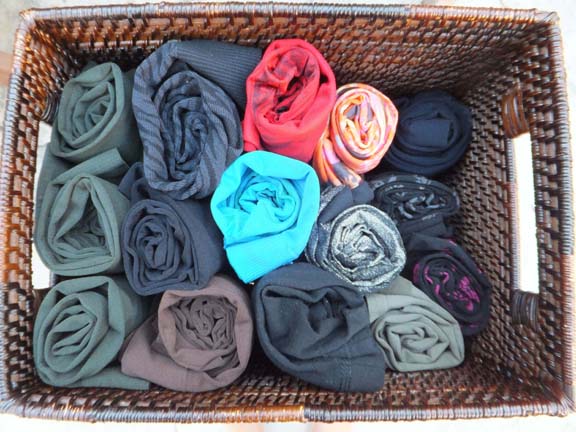
Gather and roll them up! Use a thick rubber band to keep in place. Extra hair ties and the thick rubber bands that hold fresh broccoli stalks together at the grocery store work great.

Organize socks tights 1

Step Two

Place the rolled and banded tights, leggings, or long socks upright in a drawer, basket or bin. I call this the “Cinnamon Roll.” In this view you see exactly what you have, how many, then pick and choose as you please without having to dig through a tangled and mis-matched mess. Rubber bands hold things together, so in the midst of the morning rush when changing your mind as to what color to wear, simply toss back what you don’t want without fear of unraveling…then grab another.

Organize socks tights 3

Step Three

As you grab to wear, toss the rubber bands back in to use again when laundry is done.

Organize socks tights 2

Read more cold weather closet organizing tips.

The fold and file method for thicker leggings and slim-fitting yoga pants.
“Filing” folded clothes allows you to see everything you have in a glance.

____

Ready for more? Call (510) 229-7321 today to schedule a complimentary estimate for your wardrobe and accessory organizing goals. Gift certificates are available.

Keep up with Bella Organizing on Facebook and Instagram.

Categories
Professional-Organizer

How To Let Go of Clothes That Clutter Your Closet & Your Life

When I acquire new clothing, I have a rule to let go of as many as I bring in to make room for the new and stay uncluttered. I reinforce this rule by only owning a certain amount of hangers (I hang up EVERYTHING.) How to decide what to let go? Here are tips I use myself.

I let go of clothing when:

  1. I’ve worn it to the point that it is fading, pilling, stretching, or tearing.
  2. I have not worn it for an entire year.
  3. It is no longer my color, size, or style.


skirts on hangers
Two of these five skirts have recently gone bye bye because they are no longer my style.

To elaborate…

I let go of clothing when:

  1. I’ve worn it to the point that it is fading, pilling, stretching, or tearing. Why stroll around in public with a shirt that’s old and raggedy? The only old T to own should be for events such as gardening or changing the oil. And if there’s something waiting to be mended and it’s been waiting a LONG time, I need to either GET IT DONE or GET RID OF IT.
  2. I have not worn it for an entire year. If I have not bedazzled my body with a certain piece of clothing during the last winter, spring, summer, nor fall, I likely never will. This includes my “skinny” clothes…the things I keep telling myself one day I will fit into.
  3. It is no longer my color, size, or style. Why wear something I get annoyed with every time I put it on? Not my color? Not tailored for my body? Just a little too tight or baggy? If it doesn’t make me feel fabulous nor fit just right, I get rid of it.


Common Questions from Clients

I cannot throw away things that mean a lot to me. What should I do about sentimental clothes I don’t wear?

Take a picture to preserve the memory or limit yourself to one or two pieces for the memorabilia box.

All my clothes look great and I’ve paid a lot for them. Why should I get rid of them?

Try everything on. Do not look at something and keep it because it’s cute. It must be cute on YOU, not the hanger. You also should be absolutely comfortable in it…which means you should be wearing it often enough to make it worth what you paid.

We’re thinking about having another baby and want to hold onto our child’s old clothes until we do. Should we just get rid of them?

Good for you for thinking about reusing and recycling! Go ahead and hold onto the best of it for now (be sure to box and label) and donate the rest to charity.

Thinking about letting go of clothes that are still in new or near new condition? It’s possible to make money back by consigning. Read up on some of my favorite north and east bay furniture and clothing consignment shops in the San Francisco Bay Area. Are your clothes being rejected by consignors? Simply Google “Places to donate clothes in [your city]” and plenty will pop up.  My recent favorite online clothing, shoes, and accessory consignment resources are Thredup.com (low to medium-end) and TheRealReal.com (high-end).

___

Ready for more? Call (510) 229-7321 today to schedule a complimentary estimate for your wardrobe and closet downsize & organize goals. Gift certificates are available.

Keep up with Bella Organizing on Facebook and Instagram.