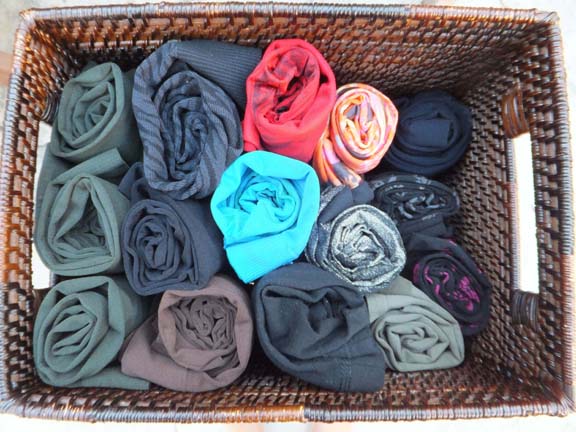
When cold weather arrives, winter clothing and accessories need to be ready and within reach. Do you have a handful of tights, leggings, long socks, or thermal underwear you depend on for warmth and comfort this time of year? It’s easy for them to get lost and tangled, especially deep inside drawers. Here are simple steps to keep them together, organized, and accessible using hair ties or rubber bands. This idea works well for kids rooms and adults always on the go.
Step One
Gather and roll them up! Use a thick rubber band to keep in place. Extra hair ties and the thick rubber bands that hold fresh broccoli stalks together at the grocery store work great.
Step Two
Place the rolled and banded tights, leggings, or long socks upright in a drawer, basket or bin. I call this the “Cinnamon Roll.” In this view you see exactly what you have, how many, then pick and choose as you please without having to dig through a tangled and mis-matched mess. Rubber bands hold things together, so in the midst of the morning rush when changing your mind as to what color to wear, simply toss back what you don’t want without fear of unraveling…then grab another.
Step Three
As you grab to wear, toss the rubber bands back in to use again when laundry is done.
The fold and file method for thicker leggings and slim-fitting yoga pants.“Filing” folded clothes allows you to see everything you have in a glance.
____
Ready for more? Call (510) 229-7321 today to schedule a complimentary estimate for your wardrobe and accessory organizing goals. Gift certificates are available.
When I acquire new clothing, I have a rule to let go of as many as I bring in to make room for the new and stay uncluttered. I reinforce this rule by only owning a certain amount of hangers (I hang up EVERYTHING.) How to decide what to let go? Here are tips I use myself.
I let go of clothing when:
I’ve worn it to the point that it is fading, pilling, stretching, or tearing.
I have not worn it for an entire year.
It is no longer my color, size, or style.
Two of these five skirts have recently gone bye bye because they are no longer my style.
To elaborate…
I let go of clothing when:
I’ve worn it to the point that it is fading, pilling, stretching, or tearing. Why stroll around in public with a shirt that’s old and raggedy? The only old T to own should be for events such as gardening or changing the oil. And if there’s something waiting to be mended and it’s been waiting a LONG time, I need to either GET IT DONE or GET RID OF IT.
I have not worn it for an entire year. If I have not bedazzled my body with a certain piece of clothing during the last winter, spring, summer, nor fall, I likely never will. This includes my “skinny” clothes…the things I keep telling myself one day I will fit into.
It is no longer my color, size, or style. Why wear something I get annoyed with every time I put it on? Not my color? Not tailored for my body? Just a little too tight or baggy? If it doesn’t make me feel fabulous nor fit just right, I get rid of it.
Common Questions from Clients
I cannot throw away things that mean a lot to me. What should I do about sentimental clothes I don’t wear?
Take a picture to preserve the memory or limit yourself to one or two pieces for the memorabilia box.
All my clothes look great and I’ve paid a lot for them. Why should I get rid of them?
Try everything on. Do not look at something and keep it because it’s cute. It must be cute on YOU, not the hanger. You also should be absolutely comfortable in it…which means you should be wearing it often enough to make it worth what you paid.
We’re thinking about having another baby and want to hold onto our child’s old clothes until we do. Should we just get rid of them?
Good for you for thinking about reusing and recycling! Go ahead and hold onto the best of it for now (be sure to box and label) and donate the rest to charity.
Thinking about letting go of clothes that are still in new or near new condition? It’s possible to make money back by consigning. Read up on some of my favorite north and east bay furniture and clothing consignment shops in the San Francisco Bay Area. Are your clothes being rejected by consignors? Simply Google “Places to donate clothes in [your city]” and plenty will pop up. My recent favorite online clothing, shoes, and accessory consignment resources are Thredup.com (low to medium-end) and TheRealReal.com (high-end).
___
Ready for more? Call (510) 229-7321 today to schedule a complimentary estimate for your wardrobe and closet downsize & organize goals. Gift certificates are available.
Roll scarves and place them in a hanging bin, basket, or drawer for easy access.
When it’s time to get organized for the changing season…
Roll scarves and place them in a hanging bin, basket, or drawer for easy access.
If you’re like most of us and have limited closet space, you may need to store seasonal clothing. In preparation for cold weather, you might consider storing away the summery things and bringing out what you’ll need to stay warm and comfortable. It’s also a good time to purge.
Purging Tips
Say “goodbye” to clothing, shoes, and accessories when:
You have worn or used it to the point of fading, pilling, stains, stretching, or tearing
You have not worn or used it for an entire year or two
It is no longer your color, size, or style
How to store off-season items.
Use containers with lids or large storage bags; cover to protect from dust, dirt, fluctuating temperatures, and little critters.
Treat them well. Clean, de-wrinkle, and fold or nicely hang before storing. Cared for clothing lasts longer, takes up less space, and can be worn immediately when it’s time.
Store items in a temperature-controlled environment, particularly natural materials such as leather, wool, and silk. Never store clothing in damp places that tend to breed mold or mildew, nor in extreme hot or cold temperatures.
Label bins or bags with a description of contents and store under the bed, high on a top shelf, in the guest room closet, on a garage shelf, or on a covered rolling rack.
Keep sweaters, jackets, scarves, warm hats & socks, cozy boots, gloves, and an umbrella within reach.
Sweaters keep their shape best when folded and stacked in dresser drawers or on reachable shelves. Lightweight sweaters do well hung as long as you wear often enough to retain their shape.
Roll winter scarves and place in a slim hanging canvas organizer in the entry closet (which I also like for small purses, hats & beanies, gloves, compact umbrellas, and other accessories,) or stack them in a dresser drawer or bin on a shelf.
Keep gloves close to scarves or within coat pockets. I buy several sets of $1 gloves at CVS or Target and store a pair in the pocket of each jacket. They’re always there when I need them.
Keep long socks, thermal underwear, and cold-weather leggings together. More tips to organize tights, leggings, and long socks here.
Take the time to organize your closet and wardrobe for the changing season, and you’ll have what you need in a cold-weather flash.
____
Ready for more? Call (510) 229-7321 today to schedule a complimentary estimate for your wardrobe and closet organizing goals. Gift certificates are available.
Moving soon? Now’s a good time to shed unwanted items…don’t pay to pack and ship them. Start a few weeks to a few months in advance (depending on the size of your home and time off work,) go at it one room at a time, and beat the clutter.
Bella Organizing Downsize Project – When spaces are too challenging for you to tackle alone, we’re here for you.
Start with an easy room.
This is an area that won’t slow you down to reminisce and in which you are less likely to get overwhelmed. Bookcases and clothing closets are good places to start, the kitchen (old food, dishes, and cooking utensils you never use) or with nic nacs around the house. Leave paperwork and photos for later; they can be a time and energy stealer, better saved for last.
Set up three boxes and label Give Away, Sell, and Donate.
1) The Give Away box is for things you want to give a friend or loved one.
2) The Sell box is for yard sale, consignment shop, or online sale items.
3) The Donate box is for charity. If all you need is a Donate box, more power to you!
Set up Trash, Recycle, and Shred bags.
You are likely to come across plastic, paper, cardboard, and non-recyclables to place in the trash. Have bags ready to declutter these items.
Having trouble deciding which clothes to purge? Read more here.
Hazardous and e-waste disposal
Paint, light bulbs, used batteries, cell phones, engine oil, broken electronics including anything with cords and wires, refrigeration, televisions, computers and monitors should not be put in the trash. They are considered hazardous or e-waste and need to be disposed of properly. Community organizations commonly hold free e-waste drop-off events on weekends, and many cities have daily drive-through and drop-off options. Visit Earth 911 to find a location near you.
Tip: Don’t take a chance on identity theft. While decluttering the office, set aside paperwork to shred.
Got paper clutter?
Don’t take a chance on identity theft. While sorting through the office, set aside paperwork to shred including documents with names, address & contact information, account numbers, social security numbers, and other information you prefer no one get their hands on in a recycle bin. Shred tons of paper at a time quickly and inexpensively at a local office supply store such as UPS, or with a shredding specialty company such as Berkeley Shreds.
Considering using donations as a tax write off?
Play it safe, take photos and make an itemized list with estimated fair market or appraised value of each item (see Salvation Army Donation Valuation Guide here). Save this and donation receipts for tax records. In the case of an audit, you may need these as proof of donation. A high-value donation write-off can be a red flag for audit at tax time. Refer to the IRS website for the latest rules on tax-deductible donations.
Isabella Guajardo has provided professional home organizing and residential move management services since 2007. She has worked with hundreds of individuals and families from all walks of life including single parents, public school teachers, college professors, lawyers, doctors, Pulitzer Prize winners, and CEOs of Fortune 500 companies. The thing 90% of them had in common? They had too much clutter and needed to downsize and reorganize.
Call (510) 229-7321 to schedule a complimentary telephone consultation.
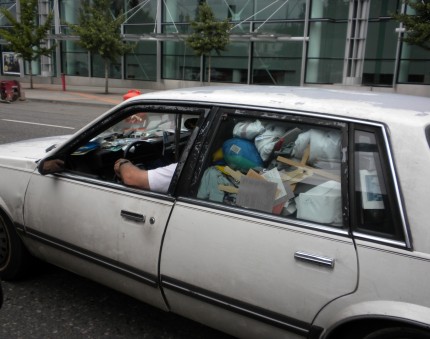
If you’re reading this it’s likely you are considering whether something you own is junkor worth keeping. Here’s an opportunity to figure it out:
When is it Junk?
When is it JUNK?
It’s JUNK if:
It’s moldy, mildew, stinky and growing spores
It’s broken or obsolete (and fixing it doesn’t make sense or is too costly)
You’ve outgrown it (physically or emotionally)
You’ve always hated it anyway
It’s the wrong color, wrong size, wrong style
Using it takes more time than its worth
You won’t really care if you ever see it again
It generates anger, bad memories or bad feelings
You have to clean it, store it, and insure it (but you don’t use it)
Storing it somewhere else would cost more than its worth
It will horrify, bore or burden your kids or the generation to come
If you can truthfully agree to one or more of these, it’s most likely junk. Do yourself, the people you live with, friends who visit and posterity a favor…get rid of it! It’s robbing you (and probably several other people) of space and mental clarity.
It’s not JUNK if:
It helps you make a living
It will do something you need done
It generates happiness, good memories and good feelings
It has high or significant cash value
It gives you more than it takes
It will enrich or delight your kids or the coming generation
If you can agree to several of the above without hesitation, it’s most likely good stuff. Enjoy, appreciate, take care of, and be sure to use it. You don’t need to re-assess its JUNKi-ness until next year.
Resources for consigning, selling, trading, donating and recycling your unwanted furniture, clothing, housewares and more can be found HERE.
____
Isabella Guajardo, a.k.a. Girl With A Truck™, is a professional home organizer and a member of the National Association of Productivity and Organizing Profressionals (NAPO). She travels in her truck to work with clients throughout the greater San Francisco Bay Area while sharing simple and creative ways to stay organized while reducing, recycling and re-purposing.
Call (510) 229-7321 to schedule a complimentary telephone assessment.