Categories
Professional-Organizer

Keep Tights, Leggings, and Long Socks Organized

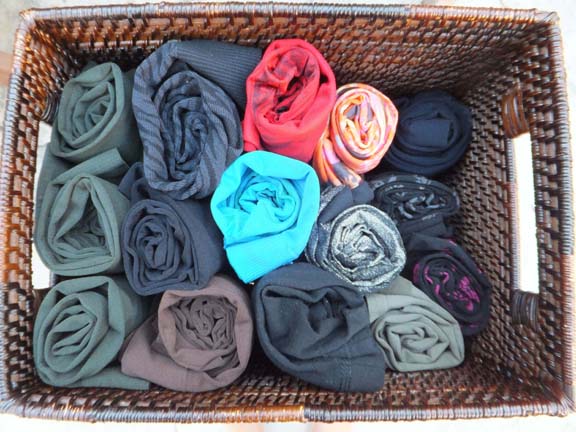
Socks rolled into their own compartments.

When cold weather arrives, winter clothing and accessories need to be ready and within reach. Do you have a handful of tights, leggings, long socks, or thermal underwear you depend on for warmth and comfort this time of year? It’s easy for them to get lost and tangled, especially deep inside drawers. Here are simple steps to keep them together, organized, and accessible using hair ties or rubber bands. This idea works well for kids rooms and adults always on the go.

Step One

Gather and roll them up! Use a thick rubber band to keep in place. Extra hair ties and the thick rubber bands that hold fresh broccoli stalks together at the grocery store work great.

Organize socks tights 1

Step Two

Place the rolled and banded tights, leggings, or long socks upright in a drawer, basket or bin. I call this the “Cinnamon Roll.” In this view you see exactly what you have, how many, then pick and choose as you please without having to dig through a tangled and mis-matched mess. Rubber bands hold things together, so in the midst of the morning rush when changing your mind as to what color to wear, simply toss back what you don’t want without fear of unraveling…then grab another.
Organize socks tights 3

Step Three

As you grab to wear, toss the rubber bands back in to use again when laundry is done.

Organize socks tights 2

Read more cold weather closet organizing tips.

The fold and file method for thicker leggings and slim-fitting yoga pants.
“Filing” folded clothes allows you to see everything you have in a glance.

____

Ready for more? Call (510) 229-7321 today to schedule a complimentary estimate for your wardrobe and accessory organizing goals. Gift certificates are available.

Keep up with Bella Organizing on Facebook and Instagram.

Categories
Professional-Organizer

Getting Ready for Winter: Wardrobe Organizing Tips for Cold Weather

When it’s time to get organized for the changing season…

scarves_declutter_decluttering_organize_bella
Roll scarves and place them in a hanging bin, basket, or drawer for easy access.

If you’re like most of us and have limited closet space, you may need to store seasonal clothing. In preparation for cold weather, you might consider storing away the summery things and bringing out what you’ll need to stay warm and comfortable. It’s also a good time to purge.

Purging Tips

Say “goodbye” to clothing, shoes, and accessories when:

  • You have worn or used it to the point of fading, pilling, stains, stretching, or tearing
  • You have not worn or used it for an entire year or two
  • It is no longer your color, size, or style

 How to store off-season items.

  • Use containers with lids or large storage bags; cover to protect from dust, dirt, fluctuating temperatures, and little critters.
  • Treat them well. Clean, de-wrinkle, and fold or nicely hang before storing. Cared for clothing lasts longer, takes up less space, and can be worn immediately when it’s time.
  • Store items in a temperature-controlled environment, particularly natural materials such as leather, wool, and silk. Never store clothing in damp places that tend to breed mold or mildew, nor in extreme hot or cold temperatures.
  • Label bins or bags with a description of contents and store under the bed, high on a top shelf, in the guest room closet, on a garage shelf, or on a covered rolling rack.

Keep sweaters, jackets, scarves, warm hats & socks, cozy boots, gloves, and an umbrella within reach.

  • Sweaters keep their shape best when folded and stacked in dresser drawers or on reachable shelves. Lightweight sweaters do well hung as long as you wear often enough to retain their shape.
  • Roll winter scarves and place in a slim hanging canvas organizer  in the entry closet (which I also like for small purses, hats & beanies, gloves, compact umbrellas, and other accessories,) or stack them in a dresser drawer or bin on a shelf.
  • Keep gloves close to scarves or within coat pockets. I buy several sets of $1 gloves at CVS or Target and store a pair in the pocket of each jacket. They’re always there when I need them.
  • Keep long socks, thermal underwear, and cold-weather leggings together. More tips to organize tights, leggings, and long socks here.

Take the time to organize your closet and wardrobe for the changing season, and you’ll have what you need in a cold-weather flash.

____

Ready for more? Call (510) 229-7321 today to schedule a complimentary estimate for your wardrobe and closet organizing goals. Gift certificates are available.

Categories
Professional-Organizer

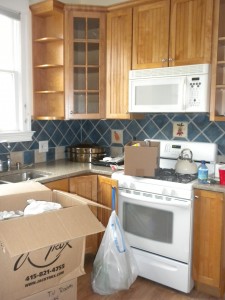
Organizing In Preparation For A Kitchen Remodel

Organizing in preparation for a kitchen remodel in berkeley and oakland

PREPARING FOR A KITCHEN REMODEL

You have the plan in hand, you’ve hired a contractor and now the day for beginning your remodeling project is quickly approaching. You need to clear the kitchen and organize the contents so that you and your family can have access to what you need with ease while the remodel takes place. If this seems overwhelming, follow these steps to simplify the process.

  • Gather supplies. You will need boxes or reusable storage bins, newspapers, packing materials, packing tape, quart and gallon size clear plastic storage bags, and markers for labeling. Avoid packing everything into one big box and having to dig through it later; use as many small 1.5 cubic foot boxes/bins as possible until you start getting to the larger and bulkier items such as pots, pans and platters.
  • Pull out items that you use every day such as the coffee maker, tea kettle, pots, skillets, rice cooker (a remodel lifesaver, especially when it comes with a vegetable steamer compartment), plates, bowls, cups, mixing bowls & cooking utensils, can opener, vegetable peelers, eating utensils. During the course of the remodel you will need these essentials. You can also use disposable/compostable cups, plates and dinnerware. Set aside storage containers for leftovers, food storage bags, foil and plastic wrap, lunch sacks. Also, make sure you have dishwashing and cleaning supplies on hand.
  • Pack eating utensils in gallon size zip-lock storage bags. Use a bag each for knives, forks and spoons. It will make it easy to access, and unpack these items once the kitchen is finished. Do the same with cooking utensils and small gadgets. Store utensils and gadgets in their own small box.
  • Pack glassware and dinnerware carefully. Even though you are packing these items for a short period of time, things can get broken in the process of carrying, stacking and storage. Wrap fragile items in newspaper or bubble wrap to protect them and seal your boxes with tape. Top the box with extra padding so the topside doesn’t sink down when the weight of another box is stacked on it…this can cause boxes to tumble and fall. Mark contents on the outside of each box.
  • Pack canned and dry foods in categories such as breakfast food, canned goods, sauces, pastas, spices, baking supplies, drinks, cooking oils, and pet food. Use small and shallow boxes to keep things organized, upright, and at-hand during the construction activity. Double check that tops are screwed on tightly before packing bottles and liquids upright.
  • Collect items you use infrequently such as holiday dinnerware, specialized bake ware, punchbowls, platters. Pack, mark and store these items in a closet, basement or garage.
  • Keep like items together when clearing out your cabinets. It’s worth taking the time to organize things now and prevent frustration later.
  • Set aside things you don’t use anymore for donation. Make a list and estimate the value before you take them to your local donation center. Throw out anything broken or unusable such as old plastic storage ware. This is a great time to reduce clutter.
  • Pack up cookbooks and recipes in their own box.
  • Take down blinds, curtains, rods and wall decorations. Place the hardware in clear plastic storage bags and label with a marker directly on the bag. Clean and dust these items if you will be using them again in the remodeled kitchen.
  • Cover computer and electronics to protect from dust. You may also want to cover furniture in adjacent rooms that may be affected by dust from the construction area.
  • Take down valuable pictures and wall hangings in adjacent rooms that can be knocked off the wall or damaged during the remodeling process.
  • Protect your pets. Keep them away from the work area.  Dogs and cats can be a danger to themselves and the work crew if they are underfoot. The best option is to keep them in a closed room away from all the work. You can also hire a pet sitter to look after your pets during an extensive remodel.


____

READ MORE BELLA ORGANIZING TIPS, IDEAS & TRAVELS HERE.

Isabella Guajardo, also known as Girl With A Truck™, is a professional home organizer and a member of the National Association of Professional Organizers (NAPO). Living in Oakland and Monterey, she travels in her truck to work with clients throughout the SF Bay Area, East Bay, South Bay, Silicon Valley, Santa Cruz and Monterey Peninsula. She shares simple and creative ways to stay organized and stylish while reducing, recycling and re-purposing. Join Bella Organizing on Facebook. Gift certificates are available.

Call (510) 229-7321 to schedule a complimentary telephone consultation.

Categories
Professional-Organizer

When is it Junk?

If you’re reading this it’s likely you are considering whether something you own is junk or worth keeping. Here’s an opportunity to figure it out:

When is it Junk?

When is it JUNK?

It’s JUNK if:

  • It’s moldy, mildew, stinky and growing spores
  • It’s broken or obsolete (and fixing it doesn’t make sense or is too costly)
  • You’ve outgrown it (physically or emotionally)
  • You’ve always hated it anyway
  • It’s the wrong color, wrong size, wrong style
  • Using it takes more time than its worth
  • You won’t really care if you ever see it again
  • It generates anger, bad memories or bad feelings
  • You have to clean it, store it, and insure it (but you don’t use it)
  • Storing it somewhere else would cost more than its worth
  • It will horrify, bore or burden your kids or the generation to come

If you can truthfully agree to one or more of these, it’s most likely junk. Do yourself, the people you live with, friends who visit and posterity a favor…get rid of it! It’s robbing you (and probably several other people) of space and mental clarity.

It’s not JUNK if:

  • It helps you make a living
  • It will do something you need done
  • It generates happiness, good memories and good feelings
  • It has high or significant cash value
  • It gives you more than it takes
  • It will enrich or delight your kids or the coming generation

If you can agree to several of the above without hesitation, it’s most likely good stuff. Enjoy, appreciate, take care of, and be sure to use it. You don’t need to re-assess its JUNKi-ness until next year.

Resources for consigning, selling, trading, donating and recycling your unwanted furniture, clothing, housewares and more can be found HERE.

____

Isabella Guajardo, a.k.a. Girl With A Truck™, is a professional home organizer and a member of the National Association of Productivity and Organizing Profressionals (NAPO). She travels in her truck to work with clients throughout the greater San Francisco Bay Area while sharing simple and creative ways to stay organized while reducing, recycling and re-purposing. 

Call (510) 229-7321 to schedule a complimentary telephone assessment.

Categories
Professional-Organizer

How To Develop A Family Technology Policy At Home

This weekend I attended the National Association of Professional Organizers (NAPO) conference for our San Francisco Bay Area Chapter. The Annual NAPO-SFBA regional conference is an opportunity for members and those interested in becoming a professional organizer to network, learn innovative ways to organize, and discover new products and services to help our clients and their families stay clutter-free and productive.

Keynote speaker Judith Kolberg, a world-renown productivity specialist, had lots of tips and information. The following is a sample list of family technology policies for the home she shared with us to share with you:


Family Technology Policies:

  • No devices at the dinner table or church
  • No texting in front of grandma
  • Lights out means no devices
  • No devices within 10 feet of water (bathtub, swimming pool, a drink on a table, etc.)
  • No tech zone in the house should be observed

What family technology policies would you implement at your home? What would be your rewards for compliance or consequences for non-compliance?

For more about Judith Kolberg and putting together a Family Technology Policy, visit http://fileheads.net/2013/09/how-to-develop-a-family-technology-policy/

For more about the National Association of Professional Organizers – San Francisco Bay Area Chapter (NAPO-SFBA) and the conference, visit: https://naposfbac.memberclicks.net/regional-conference – Hope to see you at our 2015 conference! (Location TBA)

 Judith Kolberg founded FileHeads Professional Organizers in 1989, the National Study Group on Chronic Disorganization, and the Institute for Challenging Disorganization (ICD). She is credited with launching a field of professional organizing dedicated to helping individuals challenged by chronic disorganization. Judith is the author of several books including Conquering Chronic Disorganization, which are required reading for industry certification programs (over a quarter million copies sold). She is a popular speaker and a featured organizer on the “Buried Alive” hoarding series. A native of New York, Judith lives in Atlanta, GA where she takes care of her mom, sees clients, writes, and publishes.