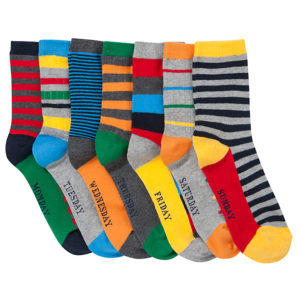
Have you taken a good look at the condition of your undergarments lately? Is your sock and underwear drawer overflowing, hard to open and close because it’s stuffed with too much? Are you a neat roller and folder, or a messy tosser and forgetter?
This week we are reviewing the state of your unmentionables: socks, underwear, bras, thongs, control undergarments, shape wear, boxers, briefs, singlets/tank tops, and undershirts. It’s time to take a good, honest look and decide whether or not these things are suitable to live on your body and take up space in your chest of drawers. You’re going to toss what is not worthy, and neatly organize the rest.
But first, let’s learn a few fun names for underwear to loosen up before you get started:
Panties
Drawers
Chonies – my favorite!
Bloomers
Skivvies
Jockeys
Undies
Knickers
Pretties
Unmentionables – I just learned this one!
10 Reasons to let those unmentionables go:
they are too tight, baggy, or stretched so wide they no longer stay up
they have holes, rips or tears you’re unwilling to repair RIGHT NOW
they don’t support what they’re supposed to support
they are made with itchy fabric
they poke, prod, or hurt in any way (that underwire bra coming unwired… ouch! You feel me?)
you’re getting infections by wearing them
they have stains so deep, the toughest bleach in the world cannot help them
they keep rolling up, rolling down, and twisting round and round
they have been laying around untouched for at least one year, for any reason. You know what that reason is.
because you simply do not like the look or feel of them on your body
Smaller bras can also be displayed this way in shallow drawers. Otherwise, the rest of us will require a deep drawer.
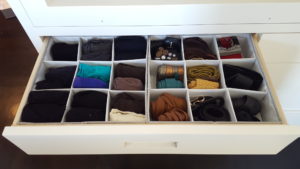
Roll socks and leggings into neat storage nooks.
Build tiny homes for rolled underwear. Or simply lay them out and stack them in a drawer.
Hang all tops including tanks and undershirts to keep them neat and wrinkle-free. Lingerie, too.
Do you prefer to keep t-shirts is drawers? Learn how to neatly fold them like this here.
Isabella Guajardo, founder and owner of Bella Organizing, is a San Francisco Bay Area professional organizer offering home organizing, interior redesign, and residential move management services throughout the Greater San Francisco Bay Area. Call (510) 229-7321 or email info@bellaorganizing.com for more information. Gift certificates are available.
Do you feel burdened by the amount of books or magazines you own? Do you find yourself lugging them around wherever you go, home to home, storage unit to storage unit, just to stack and store them on a shelf or keep them in moving boxes without ever reading them? Does the thought of getting rid of your books or magazines terrify you, as if you’d be slicing off a big chunk of your life’s history if they are no longer by your side? There are plenty of reasons to be inspired to downsize and minimize those beautiful things that provide knowledge, joy, and entertainment to all. Read on…
Reason #1 – Friends of the Public Library
Libraries everywhere are in dire need of and accept donations. Some donations are needed as regular inventory, others used to fundraise for library programs. Libraries take current best sellers, classic fiction and non-fiction, books on CD, music CDs in jewel cases, timely non-fiction, large print books, popular or classic DVDs.
A San Francisco Bay Area-based non-profit group that provides free books to prisoners across the United States. They’ve been doing it for 30 years! They accept books that help prisoners with language and vocational skills, and inform them about history and culture. The most requested are dictionaries, how-to books, and those about African-American, Latino, and Native American history and culture.
TRUE STORY
I had a client who was a world re-known author. In addition to her own writings, she had collected hundreds of boxes of literature over the years, many of which were sent to her by the authors themselves, signed and with personal notes to her. She was downsizing everything she owned, and instead of holding onto the books for longer, she made the decision to donate them to a leading research university. She felt freed from the burden she had trouble letting go of for so long, and excited that the books were going to be used for a good cause.
Reason #3
Your books may have increased, or drastically decreased, in value. It’s worth the research to know and possibly make tons of money off them.
Amazon & Ebay – Set your own price. An easy online resource to sell books, textbooks, books on CD, CDs, DVDs, and more. I suggest researching the value of your books on these websites before lugging heavy boxes to bookstores. It can be worth it to sell them yourself from the comfort of your home.
Half-Price Books (over 120 locations nationwide) – They buy books, books on CD, music, and more.
Amoeba Records (Berkeley, San Francisco, & Hollywood) – They buy CDs, DVDs, records, video games, and more.
TRUE STORY
I had a client who called me to get his office organized. When my team and I arrived, the office was FILLED with boxes of music books, music magazines, and music cds. He LOVED music and never let go of anything he collected since childhood. His goal – at first – wasn’t to downsize…until I informed him of the high value of his mint-condition heavy metal and hip hop magazines that were collecting dust. The one that excited me most was a rare Grand Royal Magazine, put out by the Beastie Boys in their heyday. “The magazine was a mix of music, culture and random things the Beastie Boys thought was cool like kung fu, demolition derby, and Moog synthesizers,” and came with a floppy 7″ Beastie Boys single inside. Only six issues were released. He spent the next several weeks online saying goodbye to his stash and hello to cash.
Isabella Guajardo, founder and owner of Bella Organizing, is a San Francisco Bay Area professional organizer offering home organizing, interior redesign, and residential move management services throughout the Greater San Francisco Bay Area. Call (510) 229-7321 or email info@bellaorganizing.com for more information. Gift certificates are available.
Whether or not you have lots of family and friends, lack of depth in at least a few relationships can leave a gaping hole in the spirit that leads to loneliness. Could focusing on the quantity of Facebook friends we are connected to, excess eating, unhealthy drinking, prolonged sleep, and/or the collection of “stuff” be signs of trying to fill an emotional void in our lives? Perhaps what the human spirit truly longs for is an abundance of meaningful relationships with other people.
Today I interview Berkeley-based psychotherapist Keely Burke, and gather favorite quotes and links to articles from leading psychologists and popular Buddhist teaching so that we may delve deeper into the question “What is Loneliness?” and gather tips on ways to both break free from, and tenderly acknowledge with loving kindness and resilience, that uncomfortable feeling that visits us throughout life.
What is loneliness?
Keely Burke, Psychotherapist
“I see loneliness as both a state and a feeling. I think of loneliness as a painful experience for people, when they are either alone or with other people, but aren’t feeling a sense of connection. Emotions associated with loneliness are often sadness, anger, anxiety, dread, fear, and terror. Loneliness can be quite painful and as with other difficult emotions, are one people can want to get away from with coping behaviors such as avoidance and addiction.
Loneliness can range from a natural and normal feeling that people sometimes have when the disconnections in relationship happen. Also, too much solitude and isolation can create the feeling. When paired with historical or current trauma experiences, loneliness can become extremely difficult. Neglect or emotional, physical, or sexual intrusion by caregivers and others early in life can make connection or lack of connection to people quite difficult.” – Keely Burke, Psychotherapist, Licensed Marriage and Family Therapist, & Expressive Arts Therapist (Berkeley, CA)
*****
Guy Winch Ph.D.
“Loneliness is a personal and subjective experience, one which is defined not by the quantity of our relationships but by their subjective quality. Not all lonely people live in isolation. A person might have many friends around them or live with a partner, yet still feel the deep ache of emotional or social isolation.” – Guy Winch Ph.D.
In his book and article, Guy Winch discusses how loneliness can begin gradually, usually as people we are close to leave us in one way or another, through a relationship break-up or death, over an argument, moving away, or when they get married and start a family of their own. Particularly as we get older, social circles cease, and we increasingly find ourselves spending time alone. Read more at: Psychology Today
“Language…has created the word ‘loneliness’ to express the pain of being alone. And it has created the word ‘solitude’ to express the glory of being alone.” – Paul Tillich, Theologian
***
“I thought about [the Buddha’s] first and second noble truths—that we suffer when we desire for circumstances over which we have no control to be other than they are.” – Toni Bernhard J.D.
Toni Bernhard J.D.
In her article “How To Turn Loneliness into Sweet Solitude,” Toni Bernhard writes about a time she became increasing lonely during her chronic illness, while bedridden and unable to socialize as she did when she was a college professor. She turned to the teachings of Buddha, through which she learned how to embrace being alone as a state of sweet solitude.
***
Priyananda
Priyananda shares the Buddhist teaching of Sarvananda, and how learning to accept aloneness is ‘where the spiritual life begins.’ ‘Buddhism challenges us to train ourselves to be more and more at ease in our own company,’ and ‘to try and be with ourselves without distraction.’ To be comfortable with ourselves, in our own skin, without the presence of others to fill the physical void, fill the hole, and make time pass. ‘Distrusting our capacity to be alone, we too quickly look to others to save us, often from ourselves,’ Sarvananda says. ‘We become addicted to other people.’
Yet, Priyananda explains, it’s when we face up to being alone that we begin to expand our thinking and begin to realize how truly we are connected, and need to be connected, with others. ‘Although we are essentially alone, we are also essentially related,’ Sarvananda explains. ‘As Buddhists, we are practicing in a context: with others and for others. The way out of loneliness or isolation, then, is to love more deeply. It is in going beyond the ego that we also go beyond loneliness and isolation.’ Read more here.
Pema Chodron
Delve deeper into the Six Kinds of Loneliness with Buddhist teacher Pema Chodron.
*****
Love More Deeply
Practice reconnecting with and loving yourself first. Psychotherapist Keely Burke* suggests that “Learning to self soothe and experience the emotions around loneliness are the ideal. Loneliness like any other emotion comes and goes like the rhythms of nature. Life experience creates times of loneliness. If we can stop resisting the emotion and just feel it, there can be a processing of the feeling and then it moves on through us leading to the next emotional state.”
*Keely Burke is a Berkeley, California based Psychotherapist, Licensed Marriage and Family Therapist, and Expressive Arts Therapist. Read more about Keely and her upcoming workshop titled Creating Self-Love at the Center for Creative Growth’s website.
When you’re ready to start loving others more deeply, begin by rekindling friendships and creating new ones.
Connect with an different old friend, acquaintance, or family member each day – in person or through a phone call, as opposed to a text message or simply commenting on their social media page. Stay positive and optimistic in your approach. Make a date to go for a walk, meet for lunch, or offer a couple hours to help with something they need done around the house. Understand that the older we get, the busier we are. Don’t take it personally or let it get you down if someone is not available right away. Schedule an appointment for a get together at a later date, and follow up on it. Continue calling different people to reconnect.
Participate in a community event in need of volunteers. Don’t worry if no one knows you, or if you show up alone. It only takes one person to make a big difference. Experiment with diverse volunteer events. When you connect with the right group of people, meaningful relationships start to develop.
Join a Meet-Up group – a safe place to get together with total strangers doing things you commonly enjoy. Hiking, writing, mother’s groups, men’s groups, meditation, dodge ball, dog walking, you name it, there’s something out there for you. Most Meet-Up’s are free, and an excellent way to be active and learn something new when on a mission to discover great people and get practice at developing meaningful relationships.
Isabella Guajardo
This article was put together by Isabella Guajardo, founder and owner of Bella Organizing, a San Francisco Bay Area professional who offers meaningful home organizing, interior redesign, and residential move management services throughout the Greater San Francisco Bay Area. Call (510) 229-7321 or email info@bellaorganizing.com for more information. Gift certificates are available.






 Isabella Guajardo, founder and owner of Bella Organizing, is a San Francisco Bay Area professional organizer offering home organizing, interior redesign, and residential move management services throughout the Greater San Francisco Bay Area. Call (510) 229-7321 or email info@bellaorganizing.com for more information. Gift certificates are available.






 Yet, Priyananda explains, it’s when we face up to being alone that we begin to expand our thinking and begin to realize how truly we are connected, and need to be connected, with others. ‘Although we are essentially alone, we are also essentially related,’ Sarvananda explains. ‘As Buddhists, we are practicing in a context: with others and for others. The way out of loneliness or isolation, then, is to love more deeply. It is in going beyond the ego that we also go beyond loneliness and isolation.’ Read more